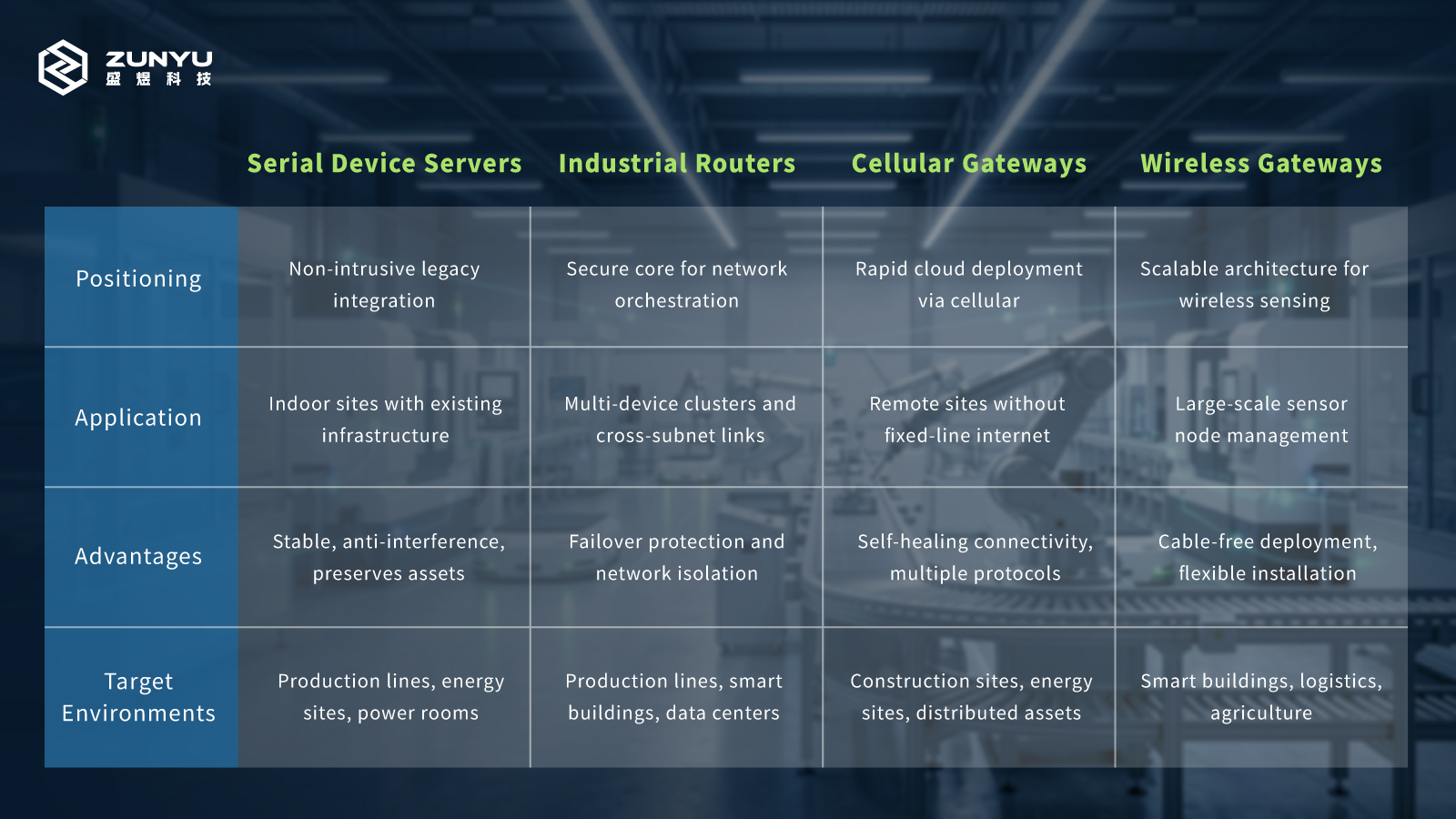

Communication Equipment: The Great Divide in System Selection

In the realms of energy management, smart buildings, and industrial automation, communication equipment may not be the visible protagonist, but it is the silent backbone of seamless data flow. The right choice can breathe new life into legacy systems; a poor one becomes a bottleneck, preventing even the most advanced sensors and platforms from reaching their full potential. This article focuses on four essential communication pillars—Serial Device Servers, Industrial Routers, Cellular Gateways, and Wireless Gateways—to help you navigate the optimal connectivity solution.
01 | Serial Device Servers: Bridging Legacy Systems with Modern Connectivity
In legacy factories, existing buildings, and power distribution sites, many meters still rely on RS-485 or Modbus communication. These devices are often deeply embedded within complex wiring and distribution panels—fixed in position and difficult to replace with modern, network-ready alternatives. This is where Serial Device Servers prove their true value: they enable a non-intrusive upgrade that preserves existing configurations while seamlessly converting data into standard network formats. By integrating legacy hardware into modern monitoring systems without operational disruption, they ensure a smoother workflow and highly controllable costs.
- Robust Interference Resistance – Built for server rooms and distribution panels to ensure long-term stability.
- Cost-Efficient Digitalization – Achieve cloud integration with minimal investment.
- Seamless Legacy Integration – Connect to smart monitoring platforms without replacing existing meters.
Target Environments ⮕ Production Lines | Energy Sites | Smart Buildings | Power Rooms
02 | Industrial Routers: The Nerve Center of Industrial Connectivity
In factories, data centers, and large-scale buildings, equipment operates in synchronized clusters, requiring both stable connectivity and structured network routing. Industrial routers serve as the core for orchestrating order in these complex environments: they offer multi-link redundancy for failover protection and provide the high processing throughput needed to integrate diverse industrial devices. By establishing seamless, reliable channels between internal and external networks, they ensure that mission-critical systems remain operational even under heavy loads or sudden disruptions.
- Seamless Failover Protection – Supports intelligent switching between wired and wireless links to eliminate downtime risks.
- High-Density Device Integration – Enables a vast array of industrial and monitoring hardware to remain online simultaneously.
- Remote Management & Traffic Shaping – Optimizes network resource allocation remotely to ensure continuous, peak performance.
Target Environments ⮕ Production Lines | Energy Sites | Smart Buildings | Data Centers
03 | Cellular Gateways: The Foundation of Cross-Site Mobile Connectivity
In construction sites, outdoor substations, and remote energy facilities where fixed-line internet is unavailable, cellular gateways serve as an agile network backbone. By establishing stable 4G/5G uplinks, they support high-density device connectivity while providing essential connection persistence mechanisms. This ensures that even the most dispersed sites can reliably backhaul data and maintain uninterrupted operations.
- Rapid 4G/5G Deployment – Establish robust connectivity instantly without the need for complex fixed-line cabling.
- Extensive Protocol Versatility – Seamlessly integrates diverse sensors, power meters, and specialized industrial hardware.
- Self-Healing Connectivity – Features intelligent link monitoring and auto-reconnect mechanisms to ensure uptime in unmanned environments.
Target Environments ⮕ Construction Sites | Energy Sites | Distributed Assets | Temporary Sites
04 | Wireless Gateways: Powering Large-Scale Wireless Sensing Infrastructure
When device counts are high, distributions are broad, and cabling costs become prohibitive, wireless gateways emerge as the optimal choice. Leveraging wireless communication technologies, these gateways centrally manage vast sensor networks, ensuring that fragmented data is stably aggregated into backend platforms. This enables continuous monitoring and management without the logistical burden of additional cabling.
- Agile Wireless Deployment – Overcomes cabling constraints, ideal for managing dispersed device clusters.
- High-Capacity Node Management – Centrally orchestrates a vast number of sensor nodes on a single platform.
- Extensive Coverage Resilience – Engineered for stable connectivity in complex architectures and expansive open sites.
Target Environments ⮕ Smart Buildings | Production Lines | Warehousing & Logistics | Smart Agriculture