

Deconstructing Core Current Sensing Technologies

In the intricate landscape of power distribution, selecting the right current sensing technology is a strategic balance between data precision, installation efficiency, and downtime risks. There is no universal standard—only the "golden ratio" tailored to your specific environment. From the time-tested stability of solid-core CTs to the operational resilience of split-core models and the spatial versatility of Rogowski coils, each technology serves a distinct strategic purpose.
01 | Solid-core CT: The Pillar of Precision and Stability
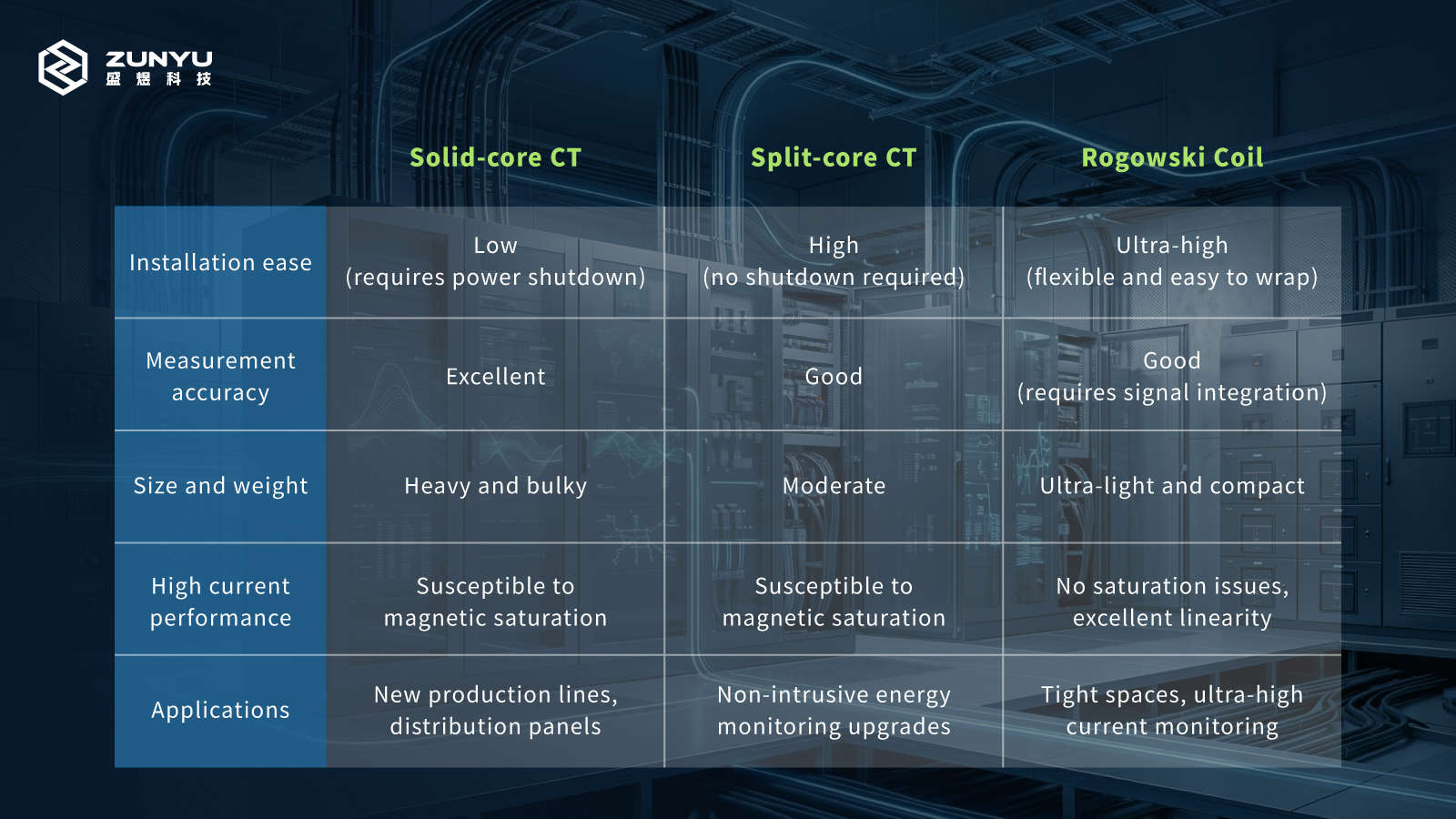
As the enduring benchmark for industrial power monitoring, traditional solid-core CTs offer exceptional linearity and measurement accuracy. Since the sensing loop is a single, integrated piece, magnetic flux loss is minimized, providing the most stable and precise electrical data available.
- Advantages – superior accuracy and durability, ideal for billing and long-term critical monitoring
- Challenges – installation requires power interruption and rewiring, creating a high barrier for sites that must remain operational
Target Environments ⮕ New construction, new machinery, and critical circuits requiring maximum precision
02 | Split-core CT: The Practical Key to Seamless Integration
For existing facilities that require retrofitting without power disruption, split-core CTs are the essential solution. Their flexible opening design allows for deployment without dismantling busbars or disconnecting cables.
- Advantages – plug-and-play convenience that significantly reduces downtime costs and labor hours while allowing sensor replacement without affecting the main circuit
- Challenges – physical gaps in the core contact points may slightly affect magnetic integrity, and the units are typically bulkier, requiring careful evaluation of cabinet space
Target Environments ⮕ Retrofit projects, energy audits, and the implementation of sub-metering systems
03 | Rogowski Coils: Mastering Spatial Constraints and High Amperage
When facing currents of thousands of amperes or crowded cabinets with dense cabling, rigid CT structures often reach their limits. Rogowski coils, with their flexible, lightweight, and thin loop structure, are engineered to overcome these spatial barriers.
- Advantages – non-magnetic core prevents saturation and ensures excellent linearity, allowing for easy installation around irregular conductors or in extremely tight gaps
- Challenges – the relatively weak output signal requires high-precision integrators for signal conversion, and accuracy can be affected by the conductor’s position within the coil
Target Environments ⮕ Tight switchgear cabinets, large transformer outputs, and power quality analysis
Data Accuracy Begins with Site Understanding
The success of energy management depends on the integrity of front-end sensing data. The historical dilemma of choosing between installation efficiency and data precision has been resolved through technological advancement. ZUNYU provides more than high-quality sensing components; we deliver a holistic vision that integrates industrial meters with diverse communication solutions, helping enterprises adapt their selection strategies to the actual field environment. Only by overcoming the hurdles of installation complexity and spatial constraints can refined energy governance truly take root, creating substantial sustainable value for the organization.